The Flip Side: Re-writing the Narrative.
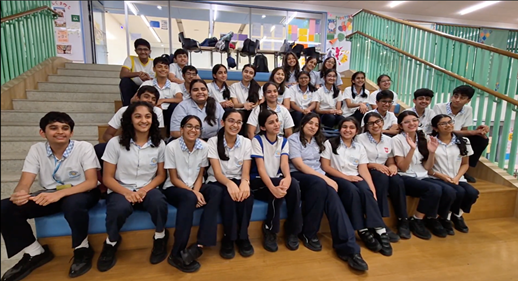
On 18 February 2026, student leaders from Nita Mukesh Ambani Junior School, hosted a Round Square Postcard titled “The Flip Side: Re-writing the Narrative.” Conceptualised and executed by students from MYP Grade 8, the Postcard aimed to challenge the traditional hero-versus-villain framework that defines many of the fairytale’s children grow up with. What started as a simple curiosity about perspective soon evolved into a powerful exploration of bias, motivation, and empathy.
Fairytales are often presented in a clear and uncomplicated manner: a virtuous hero, a wicked villain, and a storyline that leaves little room for ambiguity. From childhood, children are guided to support one character and reject another, rarely encouraged to question the narrative structure itself. However, when these stories are examined from an alternative point of view, their simplicity dissolves into complexity.
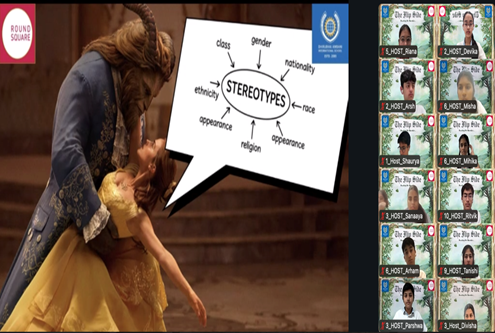
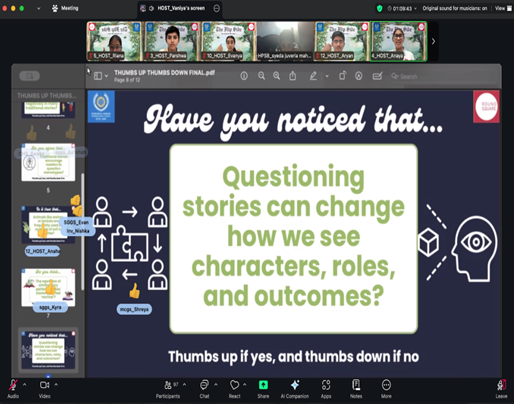
It was this realisation that became the foundation of the Postcard. The Flip Side encouraged delegates to reconsider first impressions, to question dominant narratives, and to recognise how easily stories are shaped by the perspective of the storyteller. By imagining the untold side of familiar fairy tales, delegates began to reflect on how stereotypes form and how assumptions take root, not only in literature, but in everyday life. With the theme in place, months of preparation followed.
An integral component planned in the Postcard were the breakout discussions led by student facilitators. Each Baraza was named after a traditional protagonist or antagonist from globally recognised fairytales, drawing inspiration from stories across different cultures. These sessions became the heart of the experience.
Within the breakout rooms, delegates reimagined classic fairytales from the perspective of the “villain,” while distinguishing fairy tales from other literary forms such as mythology and short stories. They also examined how cultural identity influences storytelling and debated whether stereotypes shape perspectives or whether perspectives shape stereotypes. The engaging and interactive discussions allowed delegates to move beyond passive listening. Instead, they analysed motivations, questioned assumptions, and explored how context alters understanding.
The execution of the Postcard on18th February was marked by both excitement and challenge. With participants joining from across Asia, Africa, and North America, the Postcard served as an eye-opener for the young minds. As the senior Round Square leaders mentored their juniors, they discovered that leadership is not about control, but about guidance, collaboration, and adaptability. As the session progressed, initial nervousness gradually gave way to confidence and enthusiasm. The atmosphere shifted from polite formality to genuine curiosity. By the end of the Postcard, it was evident that “The Flip Side” had resonated. Delegates walked away with more than a reinterpretation of fairytales; they carried with them a renewed commitment to empathy and open-mindedness in their everyday interactions.
Looking back, the experience proved transformative for the hosts. As they deconstructed traditional narratives, they found themselves examining their own tendencies to label and judge. Beyond the intellectual exploration, the process strengthened resilience and teamwork. Coordinating schedules, managing tight deadlines, mentoring peers, and navigating moments of stress that taught discipline, communication, and mutual support. It became a reminder that when stereotypes are questioned, spaces for empathy and meaningful dialogue are created. The Postcard reflected collective ownership and effort, of student agency in action.
Photo Gallery